Planoly vs Buffer: Social Sets, Channel Prices and Teams
- Planoly’s monthly USD references are $16, $28 and $55 for one, two and six social sets; each set contains one account per supported network.
- Buffer’s monthly Essentials and Team rates start at $6 and $12 per connected channel, with published graduated bands. Team includes approvals and unlimited members.
- Five connections can cost $16 on Planoly Starter or $30 on Buffer Essentials before tax, but that comparison does not satisfy a two-person approval requirement.
- Paid upload capacity, free waiting queues and actual platform publication are different observations. Both products advertise AI assistance; NoobClaw’s local export is a separate production record.
Planoly vs Buffer starts with the inventory: one account per network in a social set is a different purchase from individual connected channels. A useful comparison also counts people and checks the required approval workflow. This review uses current public USD references and term-matched hypothetical examples to show where the totals differ. Sources were reviewed on October 11, 2026. We have not completed a checkout or authenticated either vendor’s trial, and the figures are not customer invoices.
Count network slots, actual connections and required people separately. A lower illustrative bill does not establish that the workflow fits.
Count the social sets and the people who need access
Planoly’s pricing page defines a social set as one account on each supported network. It currently lists Instagram, Facebook, X, Pinterest, LinkedIn, YouTube, Threads and TikTok. Three Instagram accounts therefore require three sets; one Instagram account and one TikTok account can occupy two network slots in one set. These are capacity examples, not a guarantee that every format or account type supports automatic publication.
The monthly USD panel lists Starter at $16 for one set and one user, Growth at $28 for two sets and two users, and Pro at $55 for six sets and six users. The annual panel displays monthly equivalents of $14, $24 and $47. We independently switched the public panel on October 11, 2026. The selected term, tax and actual configuration remain purchase checks; an annual equivalent is not a month-to-month charge.
Growth offers additional sets at $10 monthly and users at $5; Pro’s corresponding references are $8 and $3. Starter requires an upgrade for those additions. A team must count the people who actually need access as well as the destination accounts. A spare network slot cannot accommodate a second account on that same network, and spare sets do not necessarily supply more users.
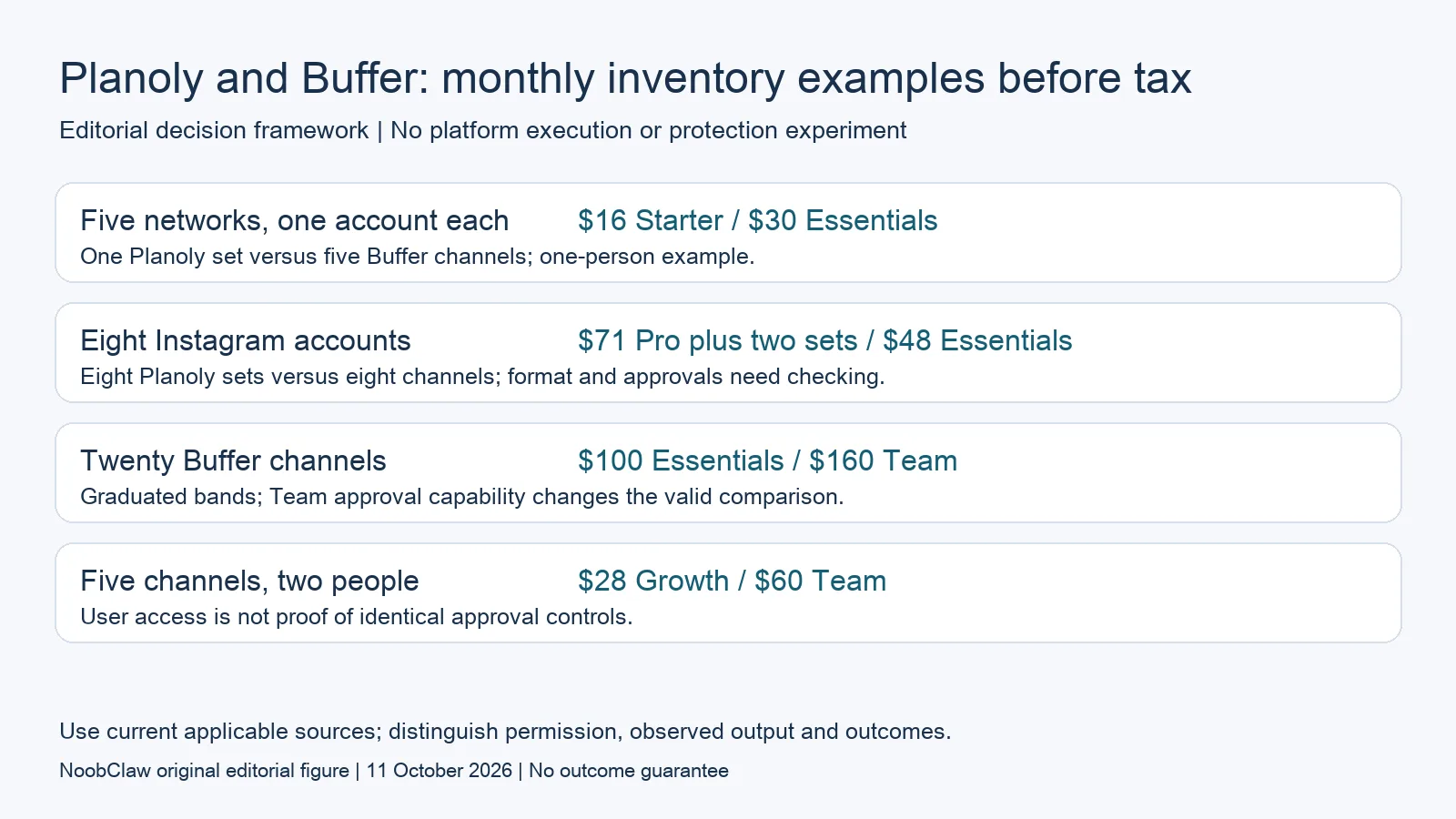
- Five networks, one account each: $16 Starter / $30 Essentials. One Planoly set versus five Buffer channels; one-person example.
- Eight Instagram accounts: $71 Pro plus two sets / $48 Essentials. Eight Planoly sets versus eight channels; format and approvals need checking.
- Twenty Buffer channels: $100 Essentials / $160 Team. Graduated bands; Team approval capability changes the valid comparison.
- Five channels, two people: $28 Growth / $60 Team. User access is not proof of identical approval controls.
Use monthly rates on both sides of the calculation
Buffer’s original pricing document publishes Essentials monthly bands of $6 for channels one through ten, $4 for eleven through twenty-five, $3 for twenty-six through fifty and $1 thereafter. Team’s corresponding rates are $12, $4, $3 and $2. A twenty-channel example therefore totals $100 on Essentials or $160 on Team before tax. The cheaper bands apply to channels in those bands; they do not reprice all earlier channels.
For an illustrative brand with one account on five supported networks and one operator, Planoly Starter’s single set lists $16 monthly. Five Buffer Essentials channels total $30. For eight Instagram accounts, Planoly Pro plus two $8 monthly set additions totals $71, while eight Essentials channels total $48. These arithmetic examples use the monthly panel and published configuration references, not annual equivalents or observed checkout results.
For three hypothetical brands with one account on each of three networks, Planoly Growth plus one additional set totals $38 monthly; nine Buffer Essentials channels total $54. This illustrates the different denominators. Before selecting either, confirm that the set arrangement, account types and required functions are eligible. Lower arithmetic cost does not establish client separation, approval access, accepted formats or an actual migration saving.
Compare the required team workflow before declaring a winner
Buffer Team advertises unlimited members and approval tools. Planoly’s user allowance and additions answer a capacity question, but the pricing material alone does not establish that its permission and approval behavior is identical to Buffer Team. A buyer who requires content to remain blocked until a named approver accepts it should verify that exact requirement in the selected plan. Merely inviting a colleague is not an observed approval control.
For five connections and two people, Planoly Growth lists two users and two sets at $28 monthly, while Buffer Team totals $60 monthly. This is a comparison of eligible stated user capacities, not certification of equivalent approval steps. Buffer Essentials is not the correct substitute when Team approval tools are required. Test who can edit, approve, schedule and publish the accepted version; retain the actual permission result.
Both vendors advertise AI assistance. We do not claim that one lacks content generation, or that their outputs have equal quality. Check the input, output and usage conditions for the specific task. A drafting assistant, a content calendar and a finished video are separate deliverables. No published feature list here establishes that an AI-generated asset is accurate, cleared for its intended use or accepted by every destination.
Read the free and paid counters in their actual units
Buffer Free supports three simultaneously connected channels and ten waiting scheduled entries per channel. Publication frees waiting space; that is a queue limit, not ten monthly publications. Buffer’s current pricing-and-features Help article separately states a lifetime limit of eight distinct channel connections for Free accounts. Disconnecting a channel does not reset that lifetime counter; paid plans are not subject to this Free condition. Check both the three simultaneous connections and this separate account-level limit before evaluating a portfolio.
Planoly’s free mobile ten-upload monthly allowance is a different counter and product surface. A short mobile preparation task can fit that offer even when a three-network waiting queue is a better fit for another operator. Calling either universally unusable or the only meaningful free option hides the task. Paid Planoly unlimited uploads likewise should not be translated into guaranteed unlimited accepted publications.
Buffer describes unlimited paid scheduling subject to a fair-use qualification of 5,000 posts per channel. The quoted clause does not establish a yearly output allowance or the detailed counting period. We do not multiply it into an annual throughput or infer that it authorizes a particular automation pattern. Preserve any destination limit and actual error separately from the subscription’s scheduling claim.
Check the accepted format and the work before scheduling
Planoly advertises unlimited uploads on its paid tiers and AI assistance with captions or keyword ideas. Those statements do not establish unlimited successful publishing on every network or an absence of API and account conditions. Its pricing page’s Schedule Posts feature section distinguishes automatic posting where supported from reminder-based work elsewhere. Inspect the actual format and account requirement rather than assuming that a connected slot means every asset can be scheduled identically.
The free mobile offer is a different workflow, with ten uploads per month. It is not interchangeable with a paid unlimited-upload plan or with another vendor’s waiting queue. The pricing page also advertises a fourteen-day trial; check the signup conditions that apply to your subscription. We have not authenticated a trial, purchased a plan or tested a cross-vendor migration in this review.
Start a trial with one representative asset and record the destination, format, required approver and publication method. A reminder requiring manual work is different from an automatic delivery. Preserve the actual accepted version and any returned status. This is an evaluation method, not a report that the vendors passed our account-specific trial or that buying a larger plan removes platform restrictions.
Choose the output you need: post-caption drafts, opening-line drafts or spoken-script drafts. These text tools have a limited anonymous allowance; they do not transcribe or publish a video.
For the related content and workflow decisions, read Planoly vs Later: Social Sets, Users and Post Limits and Buffer Free Plan Limits: Queue Slots, Users and Upgrades. Each review has its own evidence and scope.
A separate local production record, with its limits
NoobClaw publishes this article. Its public October 10, 2026 execution record documents one local creative run: 441 English input characters became a 32.6-second video at 1080 × 1920 pixels and 30 frames per second. This establishes the input and exported file for that run. It does not establish a client approval, scheduler integration, external publication, copyright clearance, monetization acceptance or audience response. Generic or off-topic stock footage still requires scene-by-scene review, and voice quality and footage rights were not independently approved. Use the bounded example to assess the separate production step. A paid plan or a successful export cannot replace review of the actual asset, the rights available for its intended use and the destination’s requirements.
NoobClaw publishes this article. Its script-to-video guide and public creative execution record document a local video result, not external-platform publication. Check the current product offer against the supported action you need.
Frequently asked questions
Is Planoly always cheaper for a brand on several networks?
No. The one-person, five-network example uses $16 Starter and $30 Essentials monthly before tax. Additional people, approval requirements, formats and available configurations can change the valid comparison.
Are Buffer’s published discounts applied to every channel?
No. The published bands price the channels in each band. Twenty monthly Essentials channels total $100 and Team channels $160 using the cited rates; tax and the actual purchase still need checking.
Does an unlimited upload claim guarantee publication?
No. Upload capacity, scheduling and a successfully published post are different observations. Verify the format, account conditions and actual delivery record.
Sources
Official material reviewed on October 11, 2026. Document conditions apply to their stated service and scope; the editorial examples are explicitly hypothetical.